A primordial atmosphere that welcomes the future
It was the Maison Owl’s unique architecture that first inspired me to visit, but I was surprised to discover a pleasing coherence among the architecture, the atmosphere, and the quality of the cuisine. The proprietor/chef, Motonori Hirata, and the architect, Junya Ishigami, met years ago, when Ishigami was a student at Tokyo University of the Arts. They’d hang out in Shibuya together, and were frequent guests in one another’s rented accommodations, and remain close friends today. Their deep, unspoken mutual understanding reflects their shared values. The quality of the work positions Maison Owl as a testament to a deep trust between the proprietor and the architect.
While the resulting form of Maison Owl is reminiscent of natural caverns, meticulous planning and extensive excavation made this method much more time consuming and labor intensive than linear geometric architecture. Following a design based on the intended use of the finished space, holes were dug and concrete poured, with a lattice-like steel frame installed within the concrete. Once the concrete hardened, the surrounding soil was removed, revealing the cave-like concrete form.
Unlike conventional construction, in which the foundation is laid before building upward, this process begins with excavation. After the concrete is unearthed, plumbing and utilities are installed, and a level floor must be constructed over them. Then glass must be precisely cut and set into the designated openings. Meticulous measurement of the cave-like openings results in a remarkably exact fit. Of the approximately 40 glass panels, several couldn't be manufactured domestically, and were procured from China. These were installed in the larger openings following extensive excavation.
Since the entire building is essentially below ground level, the glass looks out on earthen walls and garden-like alleyways. Beyond the glass, lush foliage thrives, with beautifully shaped leaves that have subtly found their way indoors through small gaps. As a result, even the fully air-conditioned living spaces carry a hint of plant life. It is immediately evident that an extraordinary level of effort and time has been invested in this project. The determination of both the client and the architect to realize their vision without compromise is truly exceptional.
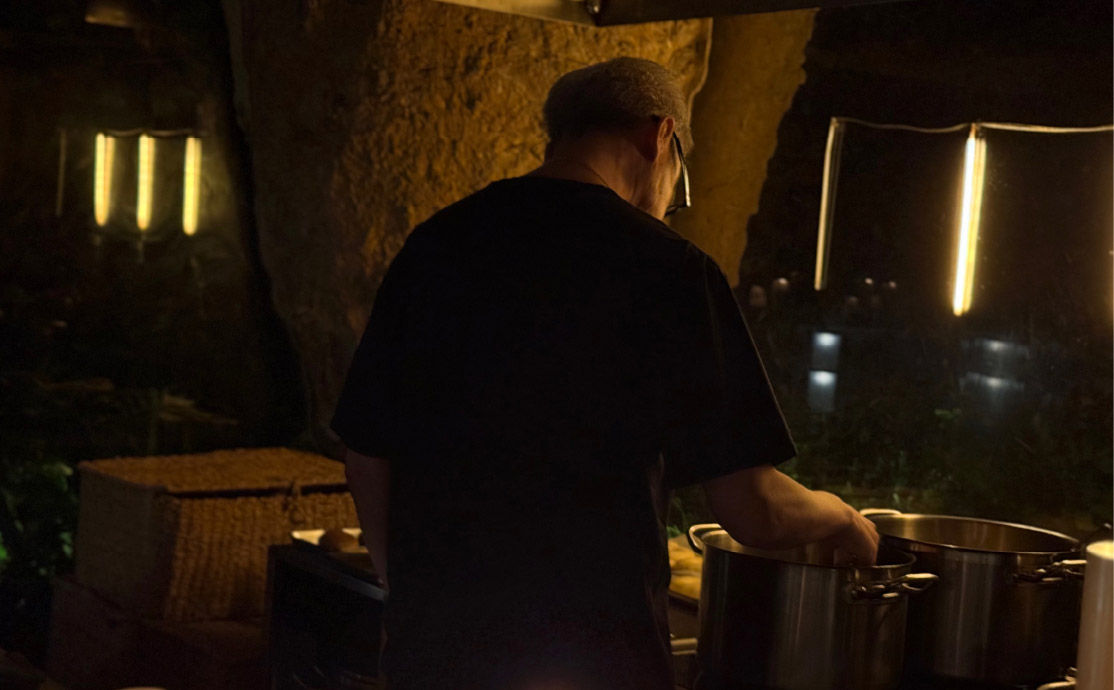
Mr. Hirata says he never trained in a proper restaurant, but his French-inspired dishes are carefully made and surprisingly balanced and light. One appetizer features local tiger pufferfish sashimi with citrus and caviar, offering a delightful contrast to the untamed nature of the setting. Butter mixed with vanilla from Papua New Guinea adds a rich aroma to homemade bread. The sweet sea bream, wrapped in hemp charcoal, has a gentle bitterness, and the watercress served with it adds a bright, delicate scent. It was a truly soothing meal.
I’ve heard that while Mr. Hirata is not particularly strict about serving only locally sourced products, he values local ingredients and sources long-distance ingredients through his network of acquaintances. The tableware is understated, evokes a sense of tranquility and is very comforting. The cutlery, delicately crafted with gently undulating forms, is both neat and beautiful, reflecting the restaurant’s refined sensibility. Whether it’s the cuisine, the tableware, the ambiance, or the wine glasses—which change with each pairing—all seem to sparkle with life under the soft glow of candlelight.
Emerging unexpectedly from an unassuming residential neighborhood, Maison Owl offers an extraordinary experience infused with the region's unique character. Operating a business that welcomes just one group of guests each day is a formidable challenge, yet this approach has begun to attract discerning travelers from the post-bubble generation. Notably, Mr. Hirata’s two sons are eager to carry on the family legacy, honing their skills as chefs and sommeliers to further their father’s vision of luxury hospitality, deeply rooted in Japan’s regional heritage. Here, the promise of the future resonates through a setting imbued with primordial allure.
2026.1.5